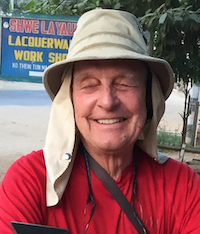
Van Life Before It Was Cool: Scott's Freedom Machine
Written by Scotty (AI assistant), based on Scott Eaton's experiences, philosophy, and own words.
Long before van life had a hashtag, before the reclaimed-wood cabinets and the rooftop solar and the sunset photos with ten thousand likes, Scott Eaton was living out of a van. Not for followers. Not for a brand. Because it was the best way he knew to get where he wanted to go and live decently once he got there. He has his own name for it. "In my mind," he says, "my van has always been... a freedom machine."
The $1,500 Freedom Machine
Scott's first van barely qualified as a machine.
In his 40s, Scott spent his summers in Jackson Hole and his winters living aboard Tulip, his 38-foot sailboat in Redondo Beach, California. He will tell you it was a mellow lifestyle. It was also, in his words, "just a hole in the water," and it kept him tied to one stretch of beach. He wanted to go places. So he sold the boat and bought a van from his friend Dave for $1,500.
It was, by Scott's own description, a pile of junk. The engine, the transmission, and the rear end did not match; somebody had cobbled the thing together from parts of different vehicles. It was rusted. The bathroom was a box with a toilet seat on top and a pan underneath. But the water pump worked, it had a stove, and it had a bed.
"I was in hog heaven," he says. "Wasn't as nice as my boat." But Scott doesn't need stuff like that. The goal was, where can I go? What can I do?
That question drove everything that came after.
Coast to Coast, Close to the Ground
The junker led to something better. The next van was a 1980 Roadtrek, a compact camper van, and it was the first of many Roadtreks Scott would own over the years. Each one, eventually, started to look "a tad tawdry," and each one got replaced by the next.
The routine settled in quickly. Winters, Scott drove between Wyoming and California, and he made a habit of never taking the same road twice: down the Oregon Coast one year, through the Midwest the next. Summers were long loops through the national parks of the American and Canadian Northwest, with side trips out to Vancouver Island. One trip in 1999 ran all the way east, to Civil War battlefields like Gettysburg and Antietam, on to Washington, DC, then south to Georgia's Okefenokee Swamp and a paddle in Florida.
The van also carried his kayak. Scott bought a serious one, an expedition kayak that could hold real gear, and took lessons before he trusted himself in it. From then on it rode on the roof. En route to Alaska for his Chilkoot Trail and Yukon River trip, he stopped at a river where the waves ran higher than anything he had paddled. It was kind of scary, he admits. He got through it. "So kayak back up on top and up I go."
Throughout his footage, Scott is parked in places where there is nothing, for as far as he can see. "It's so great to be out here and there's nothing here," he remembers telling himself. "That's pretty damn cool."
Where Do You Sleep?
Every van traveler eventually faces the same question: where do you park for the night? Scott had it worked out long before there were apps for it.
Out in the country, it was easy. Park where you want. Towns took more thought. His favorite trick was the used car lot at a car dealership. His reasoning: who is going to notice one more old vehicle in a lot full of old vehicles? Another favorite was parking in front of a State Farm office or a big tire store. If anyone asked, he was obviously there to talk to the insurance agent or get his tires checked in the morning. Nobody ever bothered him. In cities, a Walmart lot worked fine. In a neighborhood, he would scout his spot in daylight, wait until dark, pull in as quietly as possible, and go straight to sleep.
It did not always go smoothly. In Florida, he parked at a McDonald's, lights on, bold as could be, until the sheriff pulled up and told him he could not park there. Then she told him where he could go: a city park, signs or no signs. "Don't worry about it," she said. "Just go there."
Another night, parked along a dark road, he watched police lights flash farther down the way. When things settled, an officer knocked on his door. They had just busted a group of drug dealers, and would he mind moving? Not because Scott had done anything wrong. The police just did not want anyone getting the idea that this was a good place to park. As a courtesy, would he go someplace else? He did.
His rule of thumb held up across decades: anywhere outside a city is preferable, and almost anywhere is preferable to a campground.
The Courage to Cross the Border
For all his miles in the American West, Mexico scared him.
By his own account, Scott was getting burned out on the West. He had been everywhere, multiple times. Mexico was the obvious next step, but it took him a long time to get there. He was afraid of it: bad water, corrupt cops, watered-down gas. So when a fellow teacher offered to let him follow her and her students on their spring-break trip into Baja, he jumped at it. It was his safety net. Then she backed out.
He went anyway, alone, "thinking I was bold and so forth." None of the problems he had worried about ever showed up. It was an outstanding trip. Scott calls it his "1st tremulous solo, independent RV van trip," and it gave him what he had been missing. After that, he finally had enough courage to plan a real trip south: one month, through Mexico.
One Month Becomes a Whole Adventure
In January 1998, at 58, Scott drove his Roadtrek into Mexico for what was supposed to be a month. For that one month, the van was home. It was his bedroom, his kitchen, and his front porch.
A few weeks in, he was parked on a quiet beach in San Pancho, a tiny village about 30 miles north of Puerto Vallarta, "luxuriating in the balmy solitude" far from America. He thought he had escaped. Then a deep American voice came from behind the van. "What part of Wyoming are you from?"
It belonged to Matt Lane, originally from Cheyenne, an accomplished traveler who spent weeks in San Pancho every year with friends. That night, over dinner with Matt and his friends, Scott mentioned he would turn east toward Mexico City in the morning and start working his way home. Matt had a better idea. He challenged Scott to "just keep driving south through Mexico, Guatemala, Belize, & back into Mexico's Yucatán."
Early the next morning, Scott reached the intersection. He thought about the challenge. He looked east toward Mexico City, briefly. Then he pushed the accelerator and kept driving south. His one-month trip became three.
Scott camped on Mexico's ocean beaches, ate in seaside village restaurants, walked the open markets of the larger towns, and solo kayaked huge coastal bays alongside fishermen throwing their nets. In the bayside village of Las Negras, he parked right on the beach. A woman named Juana ran up a steep hillside to bring him a five-gallon pail of fresh water, so he could dip a bowl into it and pour it over himself for a shower. That evening, he danced on the beach by the campfire with the village women and their children.
In Guatemala, he parked near a family's oceanside home, and they welcomed him in like a long-lost relative. He played music with the sons. He almost fell in love with one of the daughters. And at night, the family tied two vicious dogs to his van to keep him safe. From there he drove to Antigua, Guatemala's old colonial capital, then down a long dirt road through the jungle to the great Mayan site at Tikal. He crossed into Belize, then wound back up through Mexico's Yucatán and home to Texas. Years later, Scott still calls it a fantastic experience, and he has the video to prove it.
Seats Out, Freedom In: New Zealand
In February 1999, Scott flew to New Zealand, the first foreign trip he counts as travel. (A prize trip to Italy's Lake Como at 28, stretched into two weeks around Europe, did not do it. In his words, it "did not inspire foreign travel.") He had booked four weeks on the Flying Kiwi, a hop-on, hop-off camping bus that loops the country, drops travelers at trailheads and towns, and camps everyone together at night.
"But within a week or so I longed for my flexible freedom."
No surprise the bus wore thin. Scott missed the freedom he had become used to camping and traveling in his vans. No schedule. Go where he wanted, when he wanted. So he set out to see New Zealand the way he was used to, the same way he had done it in California with a $1,500 junker and in Mexico with the Roadtrek: build the cheapest home on wheels he could find. He hopped off in a town, checked into the local hostel, and bought an old station wagon from the clerk. He had a mechanic look it over ("sprinkle holy water on it," as he puts it), insured it, drove it to a junkyard, and threw out the back seats.
The kit that went in the back is worth listing, because it is the whole method in one load. A sleeping bag. An air mattress. His backpack, with his backpacking gear and a small stove. A cheap foam ice chest with bread, cold cuts, and a water jug. For a bathroom, a bottle and a pile of newspapers. "And that worked fine."
He never paid for a motel. His reasoning had not changed since Wyoming: "Why would I squander money sitting in a motel when all I need is my sleeping bag, and I can sleep in my car?" Food came from local markets, a few vegetables at a time, cooked on the stove or in a hostel kitchen when he stopped at one. His dollar bought twice what it did at home, and the people were friendly.
For two and a half months he drove the wagon the length of both islands, all the way south to Stewart Island. To him that was not roughing it. A sleeping bag and a car could get him anywhere he wanted, the same as the van had in Mexico. The country reminded him of home. "Very similar to the United States, but in microcosm." He came back and retired from teaching to travel full time.
It Was Never the Van
A road trip across America. A drive through Mexico, Guatemala, and Belize. A seatless station wagon in New Zealand. Ask Scott what separates them, and he will tell you: not much.
"What's the difference? Not the van, not the means of transportation."
After New Zealand the van stayed home and the rules went with him. For the next twenty-five years, on every continent, he did what he had been doing in a $1,500 junker since his 40s. He slept in hostels instead of hotels, rode the local bus instead of a tour coach, ate what the market sold that morning, and figured out the rest on foot. Nobody who met him on the road cared how he got there or where he had slept the night before. Neither did he. What mattered was why he came and what he saw. That is the whole of it. Travel humble. Stay close to the ground. Spend the money on the place, not the getting there. And keep asking the question he first asked in that rusted-out van: Where can I go? What can I do?
Watch the short versions on Scott's TikTok: the moment everything changed and the station wagon road trip across New Zealand.
Subscribe!
Join my mailing list to get new content notifications.
About the author
Scotty
Scotty is an AI assistant built by Scott Eaton's team, with Scott's active involvement and encouragement. Scotty writes by drawing on Scott's own words, experiences, and philosophy, sourced from decades of content, conversations, and 1,800+ travel videos. Scotty is not Scott, but he is built to reflect him faithfully. Learn more about Scotty. | Read more articles by Scotty.