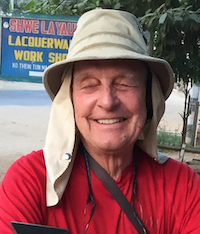
Scott's Humility
The humility & respect of a FIT traveler’s
appearance & behavior
Both humility & respect for your foreign host country are essential and must begin before you depart USA. Humility & respect work hand-in-hand.
Humility is your inner mindset of a guest seeking to learn, not judge. Respect is your outward actions toward people, their customs and surroundings.
I. Why Humility & Respect Matter:
A. Humility springs from your inner mindset; a mindset that you actually recognize & consciously cultivate in yourself. An honest belief that your life will be enhanced by your exposure to a foreign culture and its peoples; that you will become a wiser, more knowledgable, and better person. That such foreign travel will deepen your own character traits of compassion, openness, appreciation as well as your self-worth & self esteem.
Your humility will dilute the ego & arrogance, if any, that your USA culture may grant you insuring it does not slip thru to spoil your foreign travel experience. You will relish your gracious duty to be an American ambassador exemplifying the best of American virtues and respect for others.
Humility means accepting that your American (or European) way of doing things isn't automatically “better”, being willing to observe and adapt, and handling mistakes gracefully (everyone slips up culturally at some point). Without humility, "respect" may appear phony or patronizing.
B. Respect is the visible outer reflection of your inner humility …. openly demonstrating the high value you place on the local people & their culture without trying to alter it.. Not some phony act, but a truly authentic expression of your enthusiasm for & legitimate appreciation of the privilege granted you to visit a foreign culture.
Anecdote: Myanmar: On my 1st visit, unlike all other countries I traveled, Myanmar’s military dictatorship was closed to all foreigners except for Tachileik, Myanmar’s border town limits, across from Thailand’s border town Mae Sai. I spent a day attempting to absorb what little I could of Myanmar’s culture. Not much absorbed - just a wandering walk thru.
A few years later, most of Myanmar opened again. I did my research which dramatically ratcheted it up my desire to see this rich culture that riddles Asian history.
It was a spectacular month roaming Yangon’s Shwedagon Pagoda (aka the Great Dragon Pagoda), back streets & temples, electric scootering dirt country paths to walk barefoot thru the pigeon excrement covered floors of Bagan’s 2,229 temples & shrines, roaming Mandalay’s back streets, palace & temples and, finally, exploring unique Inle Lake’s floating villages.
Respect for a foreign culture avoids bizarre appearance & rowdy, culturally disrespectful behavior. Locals will not insult you as you may have done them, they will simply ignore you unless their work forces them to serve you.
In fact, often I have had locals exuberantly delight in my attempts or willingness to engage with them. It has always been my practice to look people in the eye, even strangers, and if they hold my gaze for a moment to 2, I will nod with a slight smile in recognition. Depending on the context , we may or may not engaging more. Often, they will seek me out.
In many parts of the world, Americans are appreciated because
- American culture portrayed in movies, music & on the Internet is impressive,
- They know & often aspire to America’s freedom to pursue economic success,
- they know it takes money & vacation time they don’t have to visit their country,
- I suspect they may even be pleased that you intentionally chose to visit their small village (Berat, Albania) when you might just as easily have gone to Paris, etc.
Anecdote: Family invite: Riding a bus in Tirana, Albania I chatted with a college girl, who invited me to meet her family in their home. I agreed and immediately spent several hours sipping tea and chatting with her two sisters who spoke English, my comments being translated for her mother, father & aged grandmother. Altogether a delight. Several years later I ran across her email and corresponded with her in Germany where her husband & newborn now live.
Anecdote: Don’t compare with your country with ‘back-home’: RUDE & humiliating!: Somewhere on a barren stretch of highway in the North Chilean Andes, our multi-day van tour stopped at an small, somewhat dramatic outcropping in its context of weathered sandstone very much a tiny micro version of outcroppings seen constantly on a Canyonland National Park hike. This was our guide’s ‘ooo Ah…” moment.
I was tempted to share the USA’ Four Corners area’s 130,000 square miles of endless vista of such monumental rich features, but realized, again, that would be a cruel attack on our guide’s pride in his country and its features.
Note: often hard to withstand the temptation to glorying in our American attributes that are so vast & varied. Just don’t do it. Revel in theirs
TIP: Always accept a foreign culture’s attributes in the context you find them. If a rock face is locally dramatic, appreciate it in its context, DON”T compare to elsewhere.
Anecdote: Quito, Ecuador’s Centro Comercial Del Ahorro Montufar: I often after roaming Quito’s streets & sites, I purposely migrated to the food stalls of this multi-story enclosed market for lunch. After the 1st few times they welcomed me as ‘regular (kinda). We joked & exchanged minimal pleasantries with my simple Spanish.
I always took my used plates back to the stall counter & cleaned up my table with napkins so they would not have to. Basic courtesy is appreciated everywhere.
Anecdote: an early trip (?): a local asked me how I liked their country or town and with my usual frank honesty, I pointed out some things I did not like. Immediately I realized how crest fallen and deflated was the person I spoke to. An amateur’s naïve mistake that I never made again
II. Strategies to cultivate humility & respect BEFORE leaving USA.
A. Research before trip —At home, ask Grok what are acceptable guidelines for tourist appearance & tourist behaviors and your host country’s basic customs, greetings, & taboos..

Anecdote: remove shoes in home or temple: In most of Asia you remove your shoes before entering a temple, hostel or home. I often carried my costly shoes to my room in a. plastic bag which was OK. .
Before my Myanmar trip to foil a shoe thief of my $150 shoes (most Asian sandals cost about $1 or $2 dollars), I painted them weird colors with felt tip pens to make then less desirable. 😇
Anecdote: left hand our right hand?: In Asia always eat, shake hands or hand something to someone with your right hand ONLY: left hand is for toilet use only.
B. Appearance: Appearance safety guide
Remember what you think is ‘cool’ and acceptable in America, may be offensive or disliked & subject top ridicule or worse elsewhere.
1. Wardrobe:
While scanty, shocking, or revealing attire might be considered cool, hip & bold for an American celebrity rock star in America, it may be seen as a bizarre, and disrespectful affront to your host culture’s folks,
Anecdote: No bare shoulders or knees: All over the world modest clothing (no bare knees or shoulders) is required or expected in church, temples & synagogues, often they may offer tourists a temporary covering of some sort. I always carried my self-designed, compact slip on/slip-off leggings in my rear pocket just in case my shorts might offend. NOTE: Women are not allowed in mosques,
Expensive pretentious flashy clothing suggests your are visiting to impress locals with your America’s wealth & presumed entitlement. Most insulting. Equally alarming, it may attract thieves & pickpockets.
Anecdote: Antigua, Guatemala Older Couple: an older, genteel couple ambled comfortably thru Antigua’s city park in early evening wearing their matching Abercrombie & Fitch safari outfits including hats. Instantly, advertising their tourist's wealth as an open invitation to pickpockets or worse. I empathized with their pleasurable stroll, but feared for the nasty encounters they were unknowingly inviting.
2. Face:
a. Tattoos: While tattoos have a long history in their specific cultures (New Zealand’s Māori) and may be experiencing a resurgence over the last decade or so, permanently disguising ones face or body with an array of tattoos may still seem alien to many (me).
Tattoos may limit your social connections, relationships and employment availability, nevertheless, in most society’s it still may be a personal choice.
Even in America, full face, neck & body tattoos are often seem to suggest personalty or self-worth issues, … or worse — reflection of criminal gang affiliations particularly if Latino (ie South & Central America & Mexico)
As a traveler it is wise to imagine in advance how you will be perceived or welcomed in a host culture’s country. Personally, FWIW, I find excessive full body tattoos unnerving, scary.
b. Body Piercings: while ‘cool’ amongst your peers, elsewhere it may be perceived at minimum, curious, while at worst, bizarre. ranging from trendy & unremarkable to rebellious, inappropriate, or even offensive resulting in close police, societal or customs scrutiny.
c. Beards: Beards are common place in much of world although styles may dominate specific locales, scraggly unkempt beards may draw unwanted scrutiny wit police or customs .
3. Hair: Traditional hairstyles are fine, but scraggly unkempt hair may draw unwanted customs & police scrutiny & hostel scrutiny.
C. Behavior: Behaviors safety guide
1. Customs:
Variety of customs across the world’s countries may well be endless, but easily accessed via Grok, Google etc. for the countries you will visit.
Anecdote: Thailand: 1) Don’t touch anyone’s head (sacred), 2) don’t point bottom of feet (a dirty body part) towards a Buddha statue, altar, monk, or shrine. In temples, tuck your feet behind you (e.g., "mermaid style" with legs to one side) or sit on your knees.
Anecdote: Latino’s “soft’ handshake: Early on I learned American men shake hands firmly perhaps to express manliness or our pioneer’s spirit of virility. When a teacher, I had to warn my friend & Asst Principal, Kevin, a former minor league baseball pitcher, to not crush my hand. But I still must remind myself to use the ‘soft’ handshake with my Latino friends & tenants & in various countries.
2. Consideration:
IN America, IMO, we blow our horns often because we are upset at another driver, or, if stopped in traffic too long - frustration. We believe we are entitled to our legal space & our ‘right to keep going, … and don’t mess with it.
In Thailand & Asia at large, horns blow constantly as part of an intricate system of cooperation & consideration of others using the road including cars, tour buses, semi trucks, bicycles, motorcycle and pedestrians.
Anecdote: Driving Vietnam’s narrow congested roads: On a multi-day tour of the Mekong Delta: I cajoled my way into the front passenger seat of our van so I could video the road ahead’s activity. This was a heavily used narrow 2 lane road used by all vehicles & pedestrians. Picture this,.
A narrow road, with an equally narrow shoulder on each side and right besides each shoulder is a f1 ½’ deep cement water drainage trench. A semi is ahead of us with a motorcycle coming up fast on our right side. My driver sees the motorcycle approaching, intuitively knows he is going to go between may van & the truck and then try to pass the truck on its left side in the opposing traffic’s lane.
My driver gives a couple brief horn taps while slowing enough for the motorcycle to pass between our van & the truck. Apparently the truck ahead taps his horn and opposing traffic slows just enough for the motorcycle to slip thru and pass the truck.
This was just one incident that taught me what superb considerate & skilled drivers are these Asians.
NOTE: A friend told me she sat in a similar front seat position in Asia and was cared to death. She couldn’t see the harmony.
3. Courtesy:
Respect elderly
Anecdote: Thailand’s Mae Son ‘wai’ greeting. The Wai. Hands together, head inclines. Go a little deeper when the person is older than you are. One morning I walked into a 7-Eleven, 'wai'-ed the clerk behind the register the normal way, hands below the face and a slight head bow, the action any local would recognize.
Then an elderly Thai woman a few aisles over reached for a carton of milk on a shelf she could not quite reach. I got it down for her and I 'wai'-ed her before I handed it over, much lower this time, hands much higher than they had been for the clerk because being older she was worthy of greater respect. She lit up. The clerk lit up. I walked out into that day three inches taller for no good reason.
4. Trash:
Anecdote: China bus: I tore open a snack & the wrapper inadvertently fell to the floor. I immediately jumped off my seat, picked up my trash and stuffed in my pocket. I looked sheepishly at a women across the aisle who nodded her head & smiled slightly. I believed she was thanking me for respecting her surroundings even if it is common for Chinese to throw everything on the floor or out the window.
Anecdote: Japan’s trash: I don’t recall ever seeing trash lying about in Japan. Ironically, Japan does not provide trash receptacles everywhere like the West because the culture demands that you dispose of your trash at home.
Ironically, the only trash I saw was on a trash boat plying Tokyo’s Sumida River with a slightly submerge conveyor system at the front and 2 men on either side to scoop up what the boat didn’t pick up automatically.
Much of Asia purposely throws trash INTO the rivers knowing the monsoon rains will wash them out to sea.
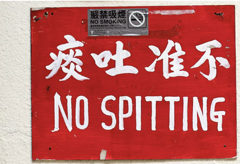
5. Spitting: Everywhere in China’s public: I observed Chinese spitting everywhere, anytime in public, however the Chinese government, as part of a broader "Civilized Tourism" campaign, was making a concerted effort to change unacceptable public behaviors with small specific issue signs as well as large 2’ x 4’ signs in English & Chinese warning against different unacceptable behaviors.
Anecdote: Chinese bus spitter: somewhere riding a Chinese bus a man frequently spat on the floor beneath him. Disgusting to me, but normal. Yet, at one Chinese tourist site was a large sign suggesting proper public behavior that specifically admonished spitting in public spaces. (Getting an idea why you take your shoes before entering a home etc.?)
6. Noisy or Loud talking:
Anecdote: Normandy, France: in a Normandy restaurant having dinner with a Wale’s family that had invited me to sit with them, Frank, the husband, commented on American’s reputation for talking loudly pointing at 2 American women talking loudly. I have seen it since. OTOH, Chinese seem to love loud noise: firecrackers, yelling etc.
7. Drunk: In the vast majority of my hostel experiences, young people left my dorm room about the time I was going to sleep, and ..came in quietly with few lights and went to bed. Very Respectful & considerate.
Anecdote: Vilnius, Lithuania hostel drunk: A young western European free of parental control for the 1st time came into my dorm room loud & drunk barfing on the floor. The hostel staff immediately shifted me to another room.
I had witnessed this foolish fledgling’s flight towards adulthood. Unfortunately, I had been equally or worse in my 20’s, so afterwards I empathized, but I still entertained his apology the next day.
8. Videoing, photos: Unless shooting from a distance, always be sensitive to subject’s sensitivities. In some cultures you may be ‘stealing’ their soul, yet, in todays ubiquitous cell phone camera selfie obsession, people are less sensitive, but still their right to decide.
Anecdote: Pingyao, China: A breakfast street vendor shooshed my camera away. I didn’t understand why, but not MY decision, HER decision only.
Often, particularly kids will clamor for me to video them. I then show video to them to their delight. Constantly, at sites people will ask if they can get a photo with me. I thought it was my dashing good looks, but defaulted to “strange old American guy” as the real draw.
Anecdote: In markets when l am obviously examining something I haven’t seen often, the vendor may say its name a couple times. Then, I will signal with my camera and they repeat a few times so I will have it recorded.
9. PDA: Public Display of Affection: strongly resented in Asia, considered tacky elsewhere accept perhaps Italy & France.
Anecdote: Rome on Dating Game trip: Roaming Rome at 28 I noticed a couple ‘making. out’ on a park bench. To far to hear, but the young man’s imploring pleadings with the girl were obvious, her coy resistance equally — in between long, long kisses.
Maybe this was the trigger that prompted my early return from Europe because unromantic European travel seemed unfulfilling; lonely.
10. Observe and follow the locals — Watch how people greet, eat, or behave in public. If in doubt, mirror what others are doing. This is humility & respect — prioritizing their norms over your habits.
D. A few local phrases: Before each trip I ALWAYS learned to pronounce at least 3 basic phrases: ”Hello”, ‘thank you’, and ‘excuse me’. The Internet can give pronunciations. I had no delusions of learning 1, let alone 3 languages on a 3 country trip. Instead, I relied on these 3 phrases, words picked up traveling, …. and everything else I did with gestures etc.
Often, I would enter a shop, saying “Hello” in the local language having practiced for few days, and they would assume I knew the language and start a rapid fire discussion. I would laugh, put up 3 fingers and recite the only 3 words I knew. And they would share in my chuckle recognizing that I had TRIED to involve myself in the culture.
Anecdote: Cairo dicey streets: I am walking a dicey side street in a neighborhood most tourists would not set foot in, and I know I am, like a unicorn, a foreigner walking down this street. I know it. I feel my own uneasiness, but I try to act calm & unassuming. I pass a stoop with a group of men drinking tea, and I offer the only two words of Arabic I really trust. Salam alaykum (Hello). Peace be upon you. One of them enthusiastically waves me over.
I chat with the group for 15 minutes translated by one who speaks English. Are you British? No, Are you Australian? No. I am American and they explode with great enthusiasm. I am humbly appreciative; treated like a guest instead of a tourist. That scene is on the Egypt Reflections page if you want the full version.
Anecdote: Lijiashan, China -“Hello”: After hiking quite a distance up the steep hill an elderly lady was walking down hill on the opposite side of the road ignoring me probably assuming I was ignoring her UNTIL as she came a breast of me I looked over and said cheerily Nǐ hǎo (‘hello’ (pronounced ‘nee how’) and she exploded with several enthusiastic Nǐ hǎo(s) (nee how) which I happily returned again.
Lijiashan, China
Irony: Often folks suggest, “You must have had a lot of interesting conversations with people around the world”. I gently remind them, “You presume they speak English or I speak their language.”
Handle mistakes with grace — If you offend someone unintentionally, apologize if you know language, otherwise, act sincerely apologetic. They will get the point.
SUM
Both humility & respect for your foreign host country are essential & together.
Humility is your inner mindset of a guest seeking to learn, not judge.
Respect is your outward actions toward people, their customs and surroundings.
Subscribe!
Join my mailing list to get new content notifications.