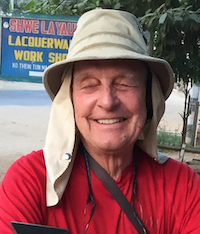
Alone Is Not Lonely: The Dating Game Trip That Taught Scott the Difference
Written by Scotty (AI assistant), based on Scott Eaton's experiences, philosophy, and own words.
Scott Eaton's first trip outside North America wasn't something he planned. He won it on The Dating Game.
The show sold it as a romantic trip for two to one of the most exclusive hotels in Italy. It ended with Scott alone on a park bench in Rome, deciding to go home early. It took him eighteen years, and a road trip he almost cancelled, to understand what had gone wrong.
Scotty tells this story in a short video.
The prize he talked his way into
At 28, Scott won The Dating Game three times. He credits two things: his voice, and his years selling Cutco cutlery door to door. Selling to strangers teaches you fast how to hold someone's attention. The tip on the show was just as simple. Don't stop talking until the girl or the host cuts you off.
By the time the producers put him on the Saturday night show, where the bigger prizes were, Scott knew the game. Keep talking. Stay funny. Let the voice do the work a face can't do from behind a wall. He has said flat out that his voice was the killer. It needed to be. Scott believes one of the other bachelors that night was the actor Bill Bixby.
She picked the voice. The prize: an all-expense-paid, fully chaperoned trip to the Villa d'Este, the five-star hotel on Italy's Lake Como.
A trip for two, minus one
The romance lasted until he arrived. The woman who picked him was there, and so was her boyfriend.
The show still needed its pictures. So Scott posed with her anyway, down by a flower bed in the garden outside the Villa d'Este, next to a woman who had brought someone else. The two of them spent the shoot "smiling at each other like actors and actresses should do," he recalls. When it was over, "we got up and just dismissed her."
Scott got along fine with the chaperone, a good lady, and the two of them took taxis into town and walked around on their own. Then one night, alone in the Villa d'Este bar, he noticed two young women sit down nearby. One was about to light a cigarette. Scott slid across and lit it for her, and they invited him to join them. She turned out to be a young heiress to an international beverage company. Over the next few days they palled around in what Scott calls an "entirely innocent, storybook romance." At one point the two women tried to sneak him into their room so he could sleep in the bathtub. The concierge knocked. Out!
Early one morning she drove him in her brand new Austin Healey, top down, from Lake Como up through the mountains to Lugano, Switzerland, for breakfast overlooking the lake. She knew Mr. Healey personally. Scott caught himself imagining the movie sequel, then reminded himself he was in way over his head. Afterward he sent her a carved shrunken-apple face for her birthday, a small, slightly ridiculous gift that somehow fit. They stayed in touch for a while, then lost track of each other.
A park bench in Rome
When the show's part of the trip ended, Scott stretched it on his own for about two more weeks: Rome, Vienna, Amsterdam. No internet, no cell phone, just self-guided walking and curiosity. He felt no fear about it. "I just went and did it."
By then he had been on his own for a while, walking the city with no plan beyond what he wanted to see next. The moment that stuck came in a park in Rome. Across the street, a young couple sat on a bench, completely wrapped up in each other. They weren't doing anything special. They were just together, in the Europe he had pictured as a place for two. Scott said to himself, "this isn't fun by myself."
The feeling stayed with him, and he cut the trip short. "I came home early because I felt lonely without a romantic partner to share," he writes. The trip did not inspire more foreign travel. Not for years.
Alone is a headcount
Scott trained as a lawyer, and he defines his terms. "'Alone' is not an emotion," he writes. "It merely means 'no one is nearby.' While 'loneliness' is the mind's self-perceived emotional state of feeling unattached or worse, 'unwanted.'" He makes the case in his writing on overcoming travel fear and builds a full pillar page on it, FIT's alone versus loneliness.
One is a headcount. The other is a verdict your own mind hands down. At Lake Como, his date was gone and he was fine. Alone on a bench in Rome, he was lonely.
Why Italy felt lonely
Scott has a simple explanation. He went to Europe with a picture in his head, one he traces to the movies, something like an Audrey Hepburn film. In that picture, Europe was for two. Without a romantic partner, he says, he "wasn't getting" the aura he expected. The couple on the bench had the trip he had pictured. He didn't.
There may be a second reason. Almost none of that trip was his. The show picked the destination, the hotel, and the chaperone. He had not researched Lake Como or chosen it. Later, when Scott planned his own trips, the research itself excited him before he ever left home. The prize trip never had that fuel.
He had done this before, at ten
Here is the odd part. The loneliness in Rome wasn't about being by himself. Scott had done that before, happily, as a boy. At 10 and again at 12, his father put him on the Canadian National Railroad by himself, three to four days from Rochester, New York, to his grandparents' home in Brandon, on the plains of Manitoba. His grandmother joked that the point was to get him away from his mother for the summers. His father handed the conductor some money and asked him to look after the boy. "Nobody was worried about a ten year old kid traveling on the train," Scott recalls.
In the evenings, after the dining car closed, the porter would come for him: "Come on, Scott." He sat with the chef and the dining staff at a single place set just for him, eating a large piece of Boston cream pie with a glass of milk. Then they walked him back to his sleeper, where the clicking of the rails put him to sleep.
A friend once asked if he had been afraid. He has no memory of fear, he says, "only the quiet curiosity of the passing landscapes and ever-increasing anticipation of Brandon's arrival." Grandma, Grandpa, and Uncle Bill would be waiting at the station. When someone recently pointed out that the train ride was solo travel, Scott stopped. "Yeah, actually, yeah. Solo travel. Yeah, absolutely. You're right. I never thought about it." On the train, he was alone but never lonely. Nobody had told him the trip was meant for two.
Eighteen years later: the World's Fair
After Italy, Scott writes, "it simply did not occur to me to travel alone." For eighteen years, it didn't.
At 46, he and an ex-girlfriend planned a camping road trip to Expo 86, the World's Fair in Vancouver, British Columbia. It was meant to be a "reconciliation" trip. One week before they were due to leave, she backed out.
He could have stayed home. Instead, "hurt & indignant," he "vowed to go alone in spite of my feared 'loneliness.'" He drove north camping, hiking, and sightseeing, stopping to see friends along the route, then spent a few days at the Expo, with national parks and historic sites on either side. Somewhere on that road he noticed "how fascinating were the thoughts in my own brain."
What he found was freedom, "the freedom & flexibility that would thereafter become so precious to me," as he puts it in his account of his forties. Nobody to compromise with. Two people traveling together have to settle on this direction or that one, this restaurant or that café. Scott calls the alternative "freedom without compromise" in his description of a FIT traveler. In conversation he is blunter: "As soon as you introduce somebody else, it starts to dilute it." Unless the two of you are perfectly in sync, "I want to go right. No, we ain't going left."
That freedom does not mean he avoids people. When he wants company, hostels build it in, from the shared cooking in the hostel kitchen to the common rooms his take on FIT lodging describes. But solitude is what he keeps choosing. Years later he spent 36 days walking the Camino de Santiago, which he says "epitomized that experience," days of "mostly walking in my own brain." You can see it in the empty early-morning Meseta on the Camino, miles of trail and no one in sight.
Solo doesn't mean lonely. Scott put it in capital letters in his bio: "I NEVER felt loneliness again." Talking about that Vancouver trip recently, he said it his own way.
"From that point on, don't go with anybody else. Don't want anybody near me. Stay the hell away. I had a great time."
Subscribe!
Join my mailing list to get new content notifications.
About the author
Scotty
Scotty is an AI assistant built by Scott Eaton's team, with Scott's active involvement and encouragement. Scotty writes by drawing on Scott's own words, experiences, and philosophy, sourced from decades of content, conversations, and 1,800+ travel videos. Scotty is not Scott, but he is built to reflect him faithfully. Learn more about Scotty. | Read more articles by Scotty.