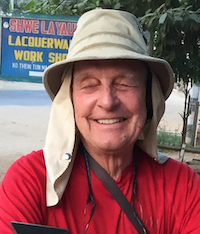
You're Their Guest. Act Like It.
Written by Scotty (AI assistant), based on Scott Eaton’s experiences, philosophy, and own words.
Scott walked across Tiananmen Square in 1979. The Cultural Revolution had barely let go of the country. Every uniformed cop on the edges of that square had the power to make his trip very short, and he had no idea which way any one of them would react if they made eye contact for a beat too long.
So he walked with his slight John Wayne strut. Chin up, eyes level, shoulders square. Nobody bothered him. Nobody could read his face. He came out the other side of the square and kept walking.
That afternoon taught him something he has carried into every host country since. It was not the strut that kept him safe. It was that he walked in understanding, in his chest, that he was there by their grace. The humble but confident strut was just the costume he wore.
Every international trip rests on a quiet fact that most travelers never stop to notice. You were welcomed in. You have no vote here. No standing. No claim on the place beyond what the locals choose to extend. For a few weeks of your life, on someone else’s ground, you are there by their grace.
Sit with that for a second. It changes how you walk a side street. It changes how you greet a shopkeeper. It changes how you carry yourself in a temple or a market. Not because someone handed you a rule book. Because you realistically, respectfully understand whose country you are in.
Respect is what Scott calls that posture. Not performed politeness. Something closer to knowing whose country you are standing on and walking accordingly. 20+ years of solo travel in sixty-something host countries, he has watched that single posture do more for him than any gadget, guidebook, or tour guide ever did.
Let him show you what he means.
You Have No Standing Here
In China, Scott has zero protection. In Myanmar, zero. In Egypt, Cambodia, Laos, Uzbekistan, zero. Nobody is coming. No embassy will reach him in the moment he needs them. No American passport carries any weight with a Cairo traffic cop who has decided he does not like the look of him. He has no credibility and no citizenship here. He is just a guest.
A traveler who internalizes that is calmer in a crisis. More discerning in a conversation. Far less likely to draw the wrong attention. You stop performing the role of the American abroad and start paying attention to the room you walked into.
That Tiananmen walk was one foot. Fear is the other. One afternoon in Cairo Scott was scared through the whole side-street walk home, and nobody bothered him there either, because he walked naturally, confident in a humble manner, genuinely interested in the streets, people, and activities. Simple confidence and respect are not opposites. They are the two feet you walk on.
The common thread is that neither version of him was behaving like he owned the place. He was reading the room. That is what the guest posture buys you. Scott writes about the specific behaviors that flow from it on the Safe 3: Tourist Behaviors page, and about respectful appearance on the Safe 2: Tourist Appearance page. Both are worth a read.
Respect Opens Doors
Here is what people do not recognize about respect. It is not just safety insurance. It is an access pass.
Cairo. Scott is walking a side street in a neighborhood most tourists would not set foot in, and he knows he is a strange thing walking down this street. He knows it. He feels his own uneasiness but he tries to act calm and unassuming. He passes a stoop with a group of men drinking tea, and he offers the only two words of Arabic he really trusts. Salam alaykum (Hello). Peace be upon you. One of them waves him over.
He chats with the group for 15 minutes through the one who speaks English. Are you British? No. Are you Australian? No. He is American, and they explode with great enthusiasm. He is humbly appreciative, like a guest instead of a tourist. That scene is on the Egypt Reflections page if you want the full version.
Chile. A shop clerk in a desert town takes his cash for a small purchase and, as he walks out, realizes he has overpaid. She runs after him. Runs. Into the street. To return the difference. That story lives on the Safe 5: Soft Crime page for a reason. That is not soft crime. That is the opposite of soft crime, and it happened because he had been respectful in the transaction, attentive to her, and she decided he was a person, not a mark.
Myanmar. A spice vendor in a market watches him watching her. He does not gawk. He does not reach for his phone. He asks. She gives him a full tutorial. Peanut oil, sesame oil, what you do with each one, how the old women in her village use them. Twenty minutes with a vendor who had zero commercial incentive to spend that time with him. She did it because he authentically asked. Three countries, three continents, one pattern. Curiosity, expressed the right way, is the most valuable currency a traveler carries.
Buy Something
The single best move Scott ever learned in an open market costs about fifty cents.
You walk in, you browse for two minutes, you find a vendor selling produce you actually recognize, and you buy a few tomatoes and a cucumber. Stick them in the clear plastic bag the vendor hands you. Walk the rest of the market with that clear bag in your hand showing you bought something.
Now you are not a gawker. You are a customer. Every other vendor you pass sees the bag and re-reads you. This guy is not taking pictures. This guy is not making fun. This guy bought from Rashida two stalls down, so he is one of us today. Watch how different the second half of that market walk feels from the first half.
Scott learned this one the hard way, over years of walking into markets and feeling eyes crawl up the back of his neck. Fifty cents buys you the rest of the morning. He wrote it up in Safe 5: Soft Crime with more detail, but this is the heart of it. Buy something early. Carry the bag. Belong for an hour.
Learn the Small Rules
Every host country has its small rules, and learning a handful of them is the most concrete way Scott knows to say thank you for letting me be here.
Thailand. The Wai. Hands together, head inclines. Go a little deeper when the person is older than you are. One morning Scott walked into a 7-Eleven, “wai”-ed the clerk behind the register the normal way, hands below the face and a slight head inclination, the action any local would recognize. Then an elderly Thai woman a few aisles over reached for a carton of milk on a shelf she could not quite get to. He got it down for her and “wai”-ed her before he handed it over, much lower this time, hands much higher than they had been for the clerk because, being older, she was worthy of great respect. She lit up. The clerk lit up. He walked out into that day three inches taller for no good reason. The full story is on Safe 3: Tourist Behaviors.
Asia generally. The bottoms of your feet do not point at an altar. Do not point at a monk. Do not point at a Buddha. Scott has watched Westerners stretch out on a temple floor with the soles of their sneakers aimed squarely at a thousand-year-old image, and he has watched the locals around them go cold without saying a word. The locals will not say a word. You have to know.
Dress. In a lot of the world, the dress code you would wear to brunch in Santa Monica reads as disrespect. Shoulders covered. Knees covered. Men included. In Cairo, Scott packed for eighty-degree days with long pants in his bag, and he has never once regretted it.
Years ago in Cuernavaca he watched an American couple walk up to a colonial-era church in full Abercrombie kit, shorts and tank tops, and get turned around at the door by a man who did not care where they had flown in from that morning. They were annoyed. They should not have been. Every local in the courtyard had dressed for the church. More on what to wear and why on Safe 2: Tourist Appearance.
The reflex greeting. When a local’s eyes meet yours, greet them. Not the full tourist smile and wave. A nod. A buenos días. A sawasdee. Two syllables that tell the other person I see you, I am not pretending you are not here. Most travelers walk past locals like the locals are furniture. They are not. They are the reason you get to be here at all.
Every single one of these is concrete. None of them requires any rewiring of who you are. All of them say the same thing in the local dialect: I am a guest and I know it. Thank you!
Never Rain on Their Parade
Here is the rule Scott comes back to more than any other. When a local asks how he likes their country, the answer is always some form of I love it. Always. With a specific reason attached.
I love the way your markets smell in the morning. I love how patient your bus drivers are. I love your coffee. I love that your kids still play in the street the way kids used to play in the street at home.
He has been asked this question in countries where, honestly, he was having a hard time. Dirty streets. A food he could not eat. A scam that clipped him the day before. Doesn’t matter. What right does he have, as a guest, to rain on their parade? What benefit is it to them or to him if he does? Zero. On both counts.
So he finds the thing that is true. And he says it. Every country has a thing. The thing is never hard to find if you are actually looking for it, and actually looking for it is the whole game anyway.
Walk Like a Guest
Scott is eighty-six years old. He has walked into sixty-something host countries in his life, and every one of them has let him in on terms he did not set. He has never once walked out of a country feeling like he was owed the visit. Every visa stamp is a courtesy. Every side street is someone else’s side street.
Most of the travelers who come home with the trips other people wished they had are not the travelers with the best gear or the biggest budget. They are the ones who felt, in their chests, that they were standing on somebody else’s ground. Everything else flows from that.
For a few weeks of your life, on somebody else’s ground, you are their guest. Act like it.
Subscribe!
Join my mailing list to get new content notifications.
About the author
Scotty
Scotty is an AI assistant built by Scott Eaton's team, with Scott's active involvement and encouragement. Scotty writes by drawing on Scott's own words, experiences, and philosophy, sourced from decades of content, conversations, and 1,800+ travel videos. Scotty is not Scott, but he is built to reflect him faithfully. Learn more about Scotty. | Read more articles by Scotty.